









Hello, we use cookies on our website to find out how many people visit the website and what services they are interested in. We can only use these files with your consent.
Library of Terms
Welcome to our glossary of terms, or if you prefer, a library of terms - a little help for anyone who wants to delve deeper into the world of sheep's wool and natural materials.
You will find simple explanations of various terms here. Without complications, in a nutshell – because even natural things deserve to be understandable.
Features
Dry heat
Dry heat is one of the main reasons why sheep's wool is so popular. This means that wool can keep you warm without making you sweaty or feeling stuffy. It wicks moisture away from your body while maintaining a comfortable temperature. It's like someone wrapped you in a blanket that breathes - it warms you but doesn't overheat you. This makes wool great not only in winter, but also for year-round wear or sleeping.
Dry heat helps with muscle, joint, and spine pain and is beneficial for blood circulation. Rheumatists, people suffering from migraines, or kidney or gynecological problems.
Wool belts and braces will warm the sore spot and help your body recover faster. Lanolin, a natural component of sheep's wool, is able to soothe irritated skin and even has limited anti-inflammatory effects.
Temperature stability
Sheep wool has thermoregulatory and insulating properties. Sheep wool shrinks and expands according to the ambient temperature. Thanks to this, it is able to take on body temperature and there is no excessive sweating or feeling of cold. When in contact with the human body, the wool warms up to a temperature of 36.6 °C and maintains it at the same level, regardless of the ambient conditions, even at high or very low temperatures.
Wool clothing keeps you pleasantly warm all year round without unnecessary overheating, making wool widely used even during the summer.
Anatomically shaped insole
An anatomically shaped (or orthopedic) insole is a specially designed inner shoe insert that follows the shape of the human foot. It provides support where the foot naturally needs it - primarily in the arch, heel and toe area.
Such an insole helps distribute the body's weight evenly, absorbs shocks while walking, and relieves foot fatigue. It is often made of soft but firm materials that promote proper posture and can prevent back, joint, or knee pain.
In woolen house shoes and slippers, the insole provides even more comfort, warmth and natural ventilation - in short, a healthy foundation for every step.
Loose hem
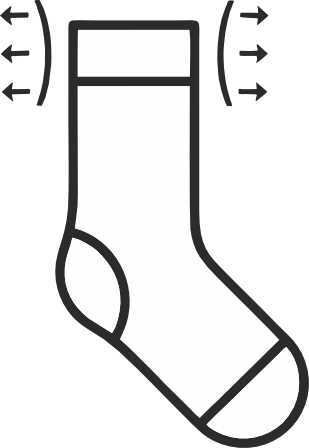
The loose hem is the end of the sock that does not constrict the foot, but at the same time keeps the sock in place. It is soft, flexible and adaptable, which does not create pressure points or leave marks on the skin, which will be especially appreciated by people with sensitive skin, swollen feet, pregnant women or diabetics.
This hem is ideal for comfortable wear during the day and while sleeping. In addition, with wool socks, it works with the properties of the material - wool breathes, warms and wicks moisture, and the loose hem makes it even more comfortable. No cutting, just a gentle hug.
Weight
Grammage determines the weight of the material per 1 m 2 . It is most often given in grams. In practice, this means that the higher the number, the denser, warmer and stronger the wool.
Materials
Fleece
Sheep wool is one of the most natural and sustainable materials available. It comes from the wool of sheep that are regularly sheared - it doesn't hurt the animals, on the contrary, it's a relief for them, especially in the warm season.
Wool has many great properties: it is warm even when wet, breathable, naturally regulates temperature and humidity, is antibacterial and self-cleaning. Thanks to this, it is often used not only for clothing, but also for bedding, children's products or decorations.
There are many different breeds of sheep, and each one produces slightly different wool. Some are known for their softness (like merino), while others are known for their durability, luster, or length of fibers. Each breed produces wool with a different character – and it is because of this diversity that we have such a wide range of yarns, felts, and fabrics.
Merino wool
Merino wool comes from the Merino sheep breed. Compared to regular sheep wool, merino is significantly finer and softer – it does not "bite" to the touch and is pleasant even for sensitive skin, including children's.
This wool is a master at thermoregulation: it keeps you warm when it's cold, but doesn't overheat when it's warmer. It's also breathable, moisture-wicking, antibacterial, and often doesn't even need to be washed often - just air it out.
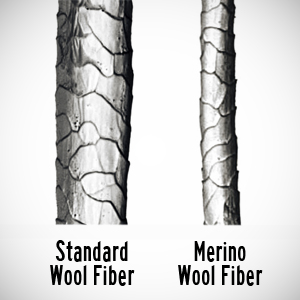
Sheep wool hair: ø 25+ μm (0.025 mm and more)
Merino wool hair: ø 16 to 21 μm (0.016 to 0.021 mm)
Human hair: ø 100 μm (0.1 mm)
Alpaca wool
Alpaca wool comes from South American llamas, which live high in the Andes. Their fur has to withstand extreme temperature fluctuations, so it's no wonder their wool is one of the warmest natural materials in the world - yet it's light, soft and beautifully silky.
Camel wool
Camel wool comes most often from Bactrian camels, which live in the harsh conditions of Mongolia, China, or Central Asia. This wool is exceptional for its softness, warmth, and lightness.
While the camel's outer coat is coarser and protects it from wind and dust, the inner undercoat (real wool) is incredibly fine and provides excellent insulation – even in extreme cold. It is these fibers that are hand-combed or collected during the natural shedding of the coat in spring.
Camel wool is:
- hypoallergenic (does not contain lanolin),
- exceptionally warm – up to 3 times warmer than sheep's wool,
- breathable and lightweight – it doesn't weigh down the body, but insulates beautifully.
It is ideal for blankets, scarves, warm socks and underlayers. Grandma Sheep uses fleece made from 10% camel wool and 90% merino sheep wool.
Cashmere wool (Cashmere)
Cashmere wool comes from the Cashmere goat, mainly raised in Mongolia, China, Iran and India. It is valued for its extraordinary softness, lightness and excellent insulating properties, which make it very warm without being bulky. The fibers are very fine (14 to 19 microns), which ensures a pleasant feeling on the skin, but they are also more fragile, so they require gentle care.
Production is demanding – one goat will only provide about 100 to 200 g of fiber per year, which is why cashmere is more expensive than regular wool. It is used for luxurious sweaters, scarves, coats and blankets. The quality depends on the length and fineness of the fibers; the best is the so-called “pashmina” made from the finest fibers.
Lanolin
Lanolin is a natural fat produced by sheep to protect their fur and skin from moisture, dirt and external influences. It is found in wool and can be partially washed out or retained during processing, depending on the type of final product.
Lanolin has amazing properties: it is antibacterial, water-repellent, while maintaining the softness and elasticity of the fibers. Thanks to this, for example, wool products (especially those with a higher lanolin content) naturally resist dirt and odor and are often cleaned simply by airing them out.
In addition, lanolin is also valued in cosmetics - you can find it in hand creams, lip balms, or baby care products, because it is very gentle on the skin and moisturizes it perfectly.
Wool with a natural lanolin content is not only wonderfully warm, but also easier to maintain - just air it out occasionally and continue to enjoy its natural charm.
Felt
Felt is a non-woven fabric made from sheep's wool that is bonded (felted) by the action of heat, moisture and friction. In this process, the individual wool fibers intertwine and firmly hold together, without the need for weaving or sewing. The result is a dense, flexible and durable material with a soft surface.
Sheep wool felt retains the natural properties of wool – it is warm, breathable, partially water-repellent and pleasant to the touch. It holds its shape perfectly, does not crack or fray.
Natural felt is also biodegradable and eco-friendly – unlike synthetic variants, it does not contain plastics or chemical additives.
Cotton
Cotton is a natural fiber obtained from the fluff of the seeds of the cotton plant, a plant grown in warm regions. It is one of the most widely used textile materials due to its softness, breathability and versatility. Cotton fibers are pleasant to the skin and absorb moisture well, which is ideal for clothing.
Fleece
Fleece is soft, pleasant to the touch and excellent at insulating heat, while being breathable and drying quickly.
Hollow fiber
As the name suggests, a hollow fiber is a tubular fiber with an empty center.
Grandma Ovečková uses 50% of hollow fiber as filling in traditional pillows, precisely because of its lightness and ability to hold its shape.
Sheepskin
Sheepskin is obtained as a by-product of sheep farming. Sheep are primarily raised for meat. Off the record: Grandma Sheep is a vegetarian.
Our sheepskin does not contain any harmful substances. Since it is a natural leather, each piece is original and it is not possible to determine the exact size and color of a given piece.
Cowhide
Cowhide, due to its strength, durability and aesthetic properties, is used for the production of slippers. The leather guarantees the slippers high resistance, durability and active breathability. Natural leather is a flexible material that easily adapts to the shape of the foot.
Suede
Suede is a general term for brushed natural leather . However, it depends on whether the leather is brushed from the back or the face. Brushed leather from the back is called velour, while brushed leather from the face is called nubuck. The leathers are soft, have a matte surface with a fine "hairy" appearance, which is a characteristic feature of this material.
Velours
Velour is a natural leather that is created by sanding the underside of the leather, the so-called back side . The front side of the material remains as a lining. Velour is a great-looking material that has a typical velvety appearance, has a short and dense pile and is very soft to the touch. Velour guarantees breathability, thus preventing excessive sweating (just like sheep's wool).
Nubuck
Nubuck is a natural leather that is created by grinding the front side . The back side of the material remains as a lining. It is characterized by a smoother, velvety surface. It is breathable, flexible and at the same time provides good anti-slip properties.
So now you know what wool, lanolin, dry heat and felt are. Each word hides a piece of nature and a lot of love that we have always put into wool.
When you pick up a wool kidney belt or blanket, you are holding something more than just material. Treat these treasures with love, and they will repay you with long service and a warm embrace whenever needed.